Jaw development & airway health
Jaw development and airway health
How a child's jaws grow shapes more than their smile: it affects facial balance, the airway and how well they breathe and sleep.

Why jaw development matters
A child's jaw growth shapes more than the smile. It affects facial balance, airway health and long-term well-being, not just whether the teeth are straight.
When the jaws develop well
- The tongue rests on the palate
- The teeth have space to align naturally
- Nasal breathing happens easily and quietly
When jaw growth is restricted or unbalanced
- Crowding or misaligned teeth
- A narrow upper jaw, or a lower jaw that sits too far back
- Mouth breathing with low tongue posture
- Snoring or restless sleep
- Flattened or elongated facial features

Normal growth and the role of breathing
In healthy development, children breathe quietly through the nose, with the lips closed and the tongue resting on the palate. This posture helps widen the upper jaw and supports balanced facial and airway development.
When a child breathes through the mouth, the tongue drops down and forward. That can narrow the palate, lengthen the face and change the shape of the airway, making it smaller and more prone to obstruction during sleep.
Key stages of jaw growth
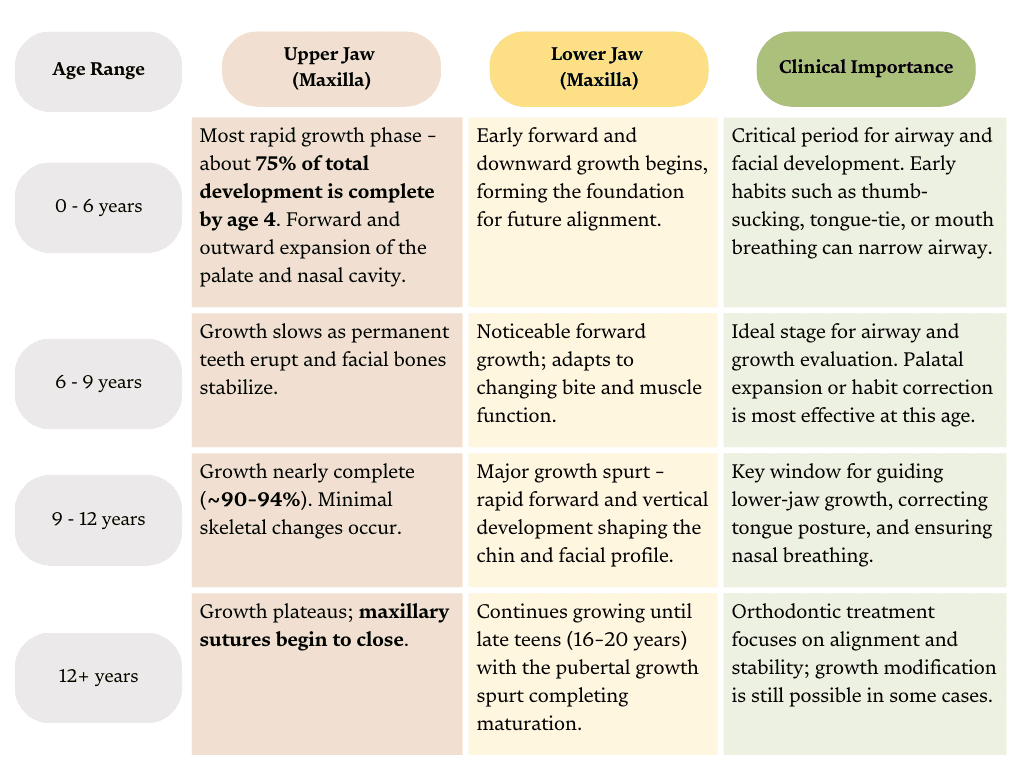
Jaw growth happens in distinct phases from infancy through adolescence, and each stage influences the size, shape and position of the airway and the overall face.
The upper jaw (maxilla) develops earlier and faster, while the lower jaw (mandible) keeps growing for longer, which is why early evaluation is valuable.
Jaw growth by age
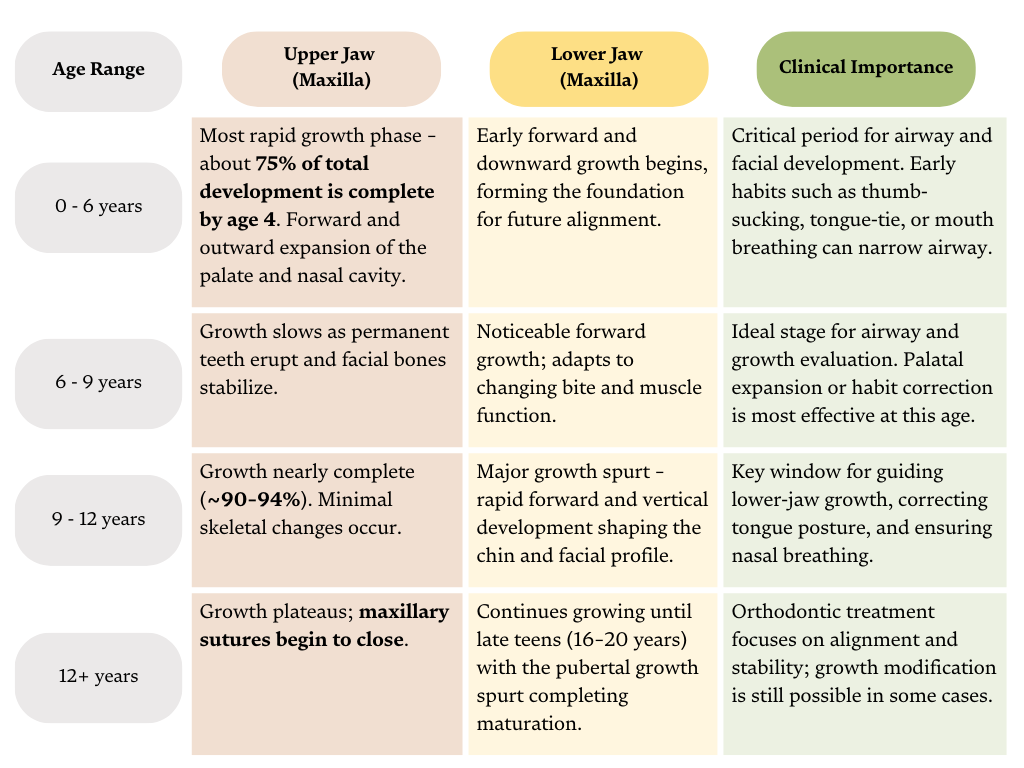
- 0 to 6 years: the upper jaw is in its most rapid growth phase, with about 75% of total development complete by age 4, while the lower jaw begins its early forward and downward growth. Habits such as thumb-sucking, tongue-tie or mouth breathing can narrow the airway at this stage.
- 6 to 9 years: upper-jaw growth slows as the permanent teeth erupt and the facial bones stabilise. This is an ideal stage for airway and growth evaluation, when palatal expansion or habit correction tends to be most effective.
- 9 to 12 years: upper-jaw growth is nearly complete, around 90 to 94%, while the lower jaw goes through a major growth spurt that shapes the chin and profile. This is a key window for guiding lower-jaw growth, tongue posture and nasal breathing.
- 12 years and older: growth plateaus and the upper-jaw sutures begin to close. The lower jaw keeps growing into the late teens, and treatment focuses on alignment and stability, though some growth modification is still possible.
Why tongue position and nasal breathing matter
The tongue acts almost like a natural orthodontic appliance. Its gentle pressure against the palate helps shape and maintain a broad, U-shaped dental arch, which supports tooth alignment and a healthy airway. Nasal breathing keeps the tongue in that position and promotes normal muscle tone in the lips, cheeks and jaws.
When posture is poor, with the tongue low and the mouth open, the upper jaw narrows, the lower jaw rotates backward, and airway space decreases. Over time this can lead to mouth breathing, snoring, sleep-disordered breathing and long-term dental instability.
How mouth breathing affects sleep
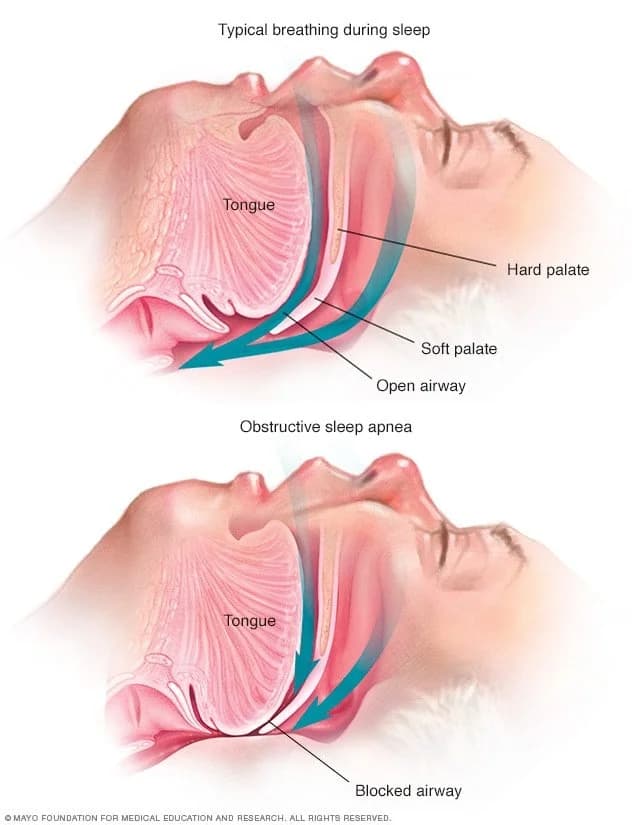
Mouth breathing dries the airway and lowers airflow stability during sleep. The tongue sits low and the jaw can fall back, narrowing the airway, which increases vibration, heard as snoring, and the chance of the airway collapsing.
The result is fragmented sleep, with less deep and REM sleep. During the day this can show up as tiredness, irritability and poor concentration.
Sleep-related breathing disorders and sleep apnea
Sleep-related breathing disorders (SRBD) cover abnormal breathing during sleep, from mild snoring to obstructive sleep apnea (OSA). OSA happens when the upper airway becomes partly or fully blocked during sleep, causing pauses in breathing and drops in oxygen.
Several everyday factors can restrict jaw width and forward growth, reduce airway size, and raise the chance of snoring, mouth breathing or sleep-disordered breathing in children. An airway-focused dental assessment looks for these patterns.
Common contributing factors
- Mouth breathing or chronic nasal blockage
- Oral habits such as thumb-sucking or tongue thrusting
- Low tongue posture and a weak lip seal
- Genetic predisposition
- Postural or dietary influences
Why early intervention matters
Identifying these patterns early lets us guide growth rather than try to correct it later. Improving tongue posture, nasal breathing and muscle balance supports healthier jaw and airway development while a child is still growing.
Our airway-focused approach emphasises early assessment, often around age 7, and works alongside paediatricians and ENT specialists where needed. The aim is to support healthy breathing, balanced facial growth and restful sleep.
Benefits of early airway-focused care
- Better airflow and oxygen levels
- Improved sleep and focus
- More balanced facial proportions
- A lower chance of needing extractions or surgery later
Questions & answers
Jaw development & airway health: common questions
At what age should jaw development be assessed?
Can the way the jaw develops really affect my child's face?
How is jaw development guided?
Book a visit
Ready to take care of your smile?
Tell us what you need and our team will help you book the right appointment, usually within one working day.