
Dental glossary
Dental crown
A custom-made cap that covers a damaged or weakened tooth to restore its shape, strength and appearance.
This page is general information, not a diagnosis or treatment recommendation. For advice about your own teeth, or your child's, please speak to a dentist.
What a dental crown is
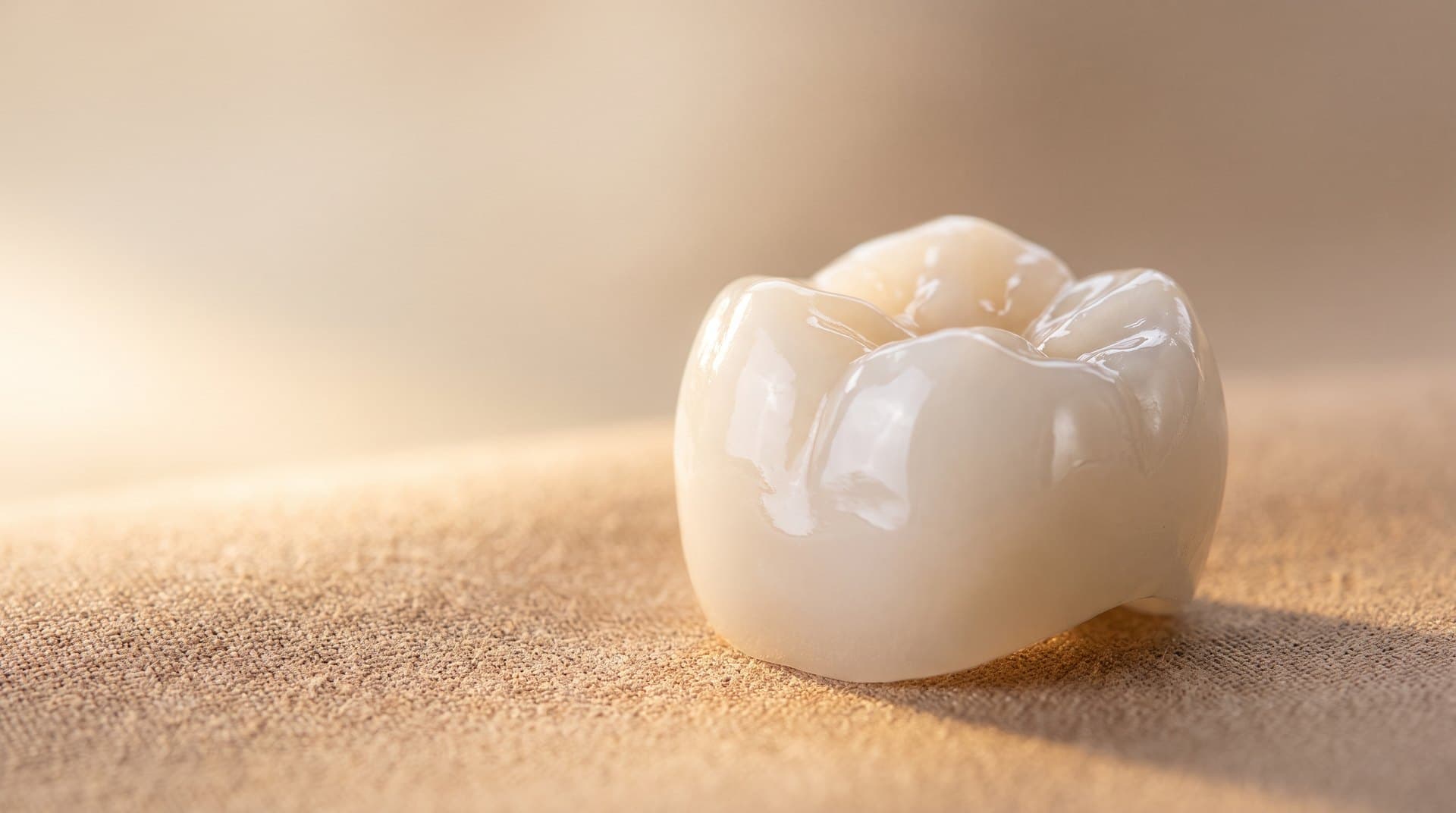
A dental crown is a cap that fits over a tooth, covering the part above the gum to restore its shape, size, strength and appearance. It is sometimes called a cap because it sits over the whole visible tooth, unlike a filling, which replaces only part of it. A crown can also be fitted on top of a dental implant.
Crowns are custom-made to match the surrounding teeth, so a well-fitted crown is designed to look and function like a natural tooth.
When a crown might be used
A crown is generally considered when a tooth is too damaged or weakened for a simpler repair to be reliable. Common situations include a tooth with a large filling, a tooth that has had root canal treatment, or a cracked or heavily worn tooth that needs protecting. The aim is to hold the tooth together and let it work normally.
Whether a crown is the right choice, or whether a filling or another option would do, depends on how much healthy tooth remains and where the tooth sits in the mouth. A dentist assesses this before recommending anything.
Crowns are often used to
- Protect a tooth weakened by a large filling or a crack
- Restore a tooth after root canal treatment
- Cover and support an implant or a bridge
Materials and what's involved
Crowns can be made from porcelain or ceramic, from metal, or from combinations of materials. Tooth-coloured options are often chosen for visible teeth, while strength may be the priority further back. The most suitable material depends on the tooth and the bite.
Fitting a crown usually involves preparing the tooth, taking an impression or scan, and fitting the finished crown, sometimes with a temporary crown in between while the permanent one is made. Local anaesthetic is generally used where needed. A dentist will explain the steps for your particular tooth.
Crowns on implants and bridges
A crown is not only used to cover a natural tooth. It is also the visible part of a dental implant, fitting onto the abutment that connects to the post in the jawbone, and crowns form the anchoring teeth at each end of some dental bridges.
In each case the principle is the same: a custom-made cap that restores the shape and function of a tooth. What differs is what sits beneath it, which is part of why treatment is planned around the individual situation.
Caring for a crown
A crowned tooth is cared for in the same way as a natural tooth. The crown itself does not decay, but the natural tooth underneath and the gum around it still can, so brushing, cleaning between the teeth and routine check-ups remain important.
It is worth having a crown looked at if it ever feels loose, if the bite feels different, or if the gum around it becomes sore. Catching any issue early gives the best chance of a simple solution.
Keeping a crowned tooth healthy
- Brush and clean between the teeth as usual
- Keep up routine check-ups so the tooth and gum are monitored
- Mention any looseness, soreness or change in the bite
Questions & answers
Dental crown: common questions
What is the difference between a crown and a filling?
Is a crown the same as a veneer?
How long does a crown last?
Related glossary terms
On treatment at Align Dental, see: Dental bridges.
Book a visit
Ready to take care of your smile?
Tell us what you need and our team will help you book the right appointment, usually within one working day.